

Detailed view
Immersive movements simulators (Versailles)
The immersive traffic simulation platform in Versailles enables the study of the behaviour and interactions of different road users – pedestrians, cyclists and motorists – in controlled, realistic and reproducible situations. It enables research into urban transformation and new forms of mobility, particularly in the areas of road safety, sustainable mobility, connected and automated vehicles, and the coexistence of humans and robots.
It is based in particular on a CAVE-type immersive simulator, comprising a projection space measuring 8.5 m long × 4.5 m wide × 2.8 m high, equipped with a spatial sound system and a motion tracking system. Unlike systems based on virtual reality headsets, the CAVE offers large-scale immersion without the need for equipment worn on the head or in front of the eyes. Participants thus retain a natural field of vision and a direct perception of their environment, whilst moving through a virtual scene. This particularly unobtrusive setup is well-suited to observing behaviour and interactions between multiple users, for example when a pedestrian crosses a road in the presence of motor traffic.
The platform also features an XR space housing various virtual and mixed reality devices to simulate the movements of pedestrians, cyclists and motorists. For example, walking experiences can utilise locomotion platforms or various movement metaphors, whilst cycling experiences rely in particular on exercise bikes fitted with immersive headsets. This equipment can operate independently or be interconnected, enabling several users to move within the same scenario and replicate complex urban situations.
This ability to interconnect makes it possible, in particular, to study the coexistence of different modes of transport, but also to explore new situations linked to the arrival of automated and connected vehicles, delivery, service or assistance robots, and other autonomous systems in the urban environment.
By immersing participants in virtual environments, simulators enable their behaviour to be studied in controlled, reproducible and safe situations. In particular, they offer the opportunity to explore new, future-oriented or difficult situations – or even those that would be impossible to replicate under real-world conditions.
Complementing experiments carried out on test tracks or in real-world situations, these systems make it possible to anticipate the uses and transformations of the city of tomorrow, to evaluate different urban configurations and to test new mobility and urban planning solutions at an early stage. The platform thus serves as a tool for exploring future challenges relating to mobility, road safety and the coexistence of humans, vehicles and robots.
Practical information
Thématique
- Mobility and simulation
- Driving simulators
Secteur(s) applications
- Automotive industries
- Industries of the Future Solutions
Laboratory
- COSYS / Pics-L - Perceptions, Interactions, Comportements & Simulations des usagers de la route et de la rue
Domaine(s) expertise
- Virtual reality
- Driving simulation
Some photos
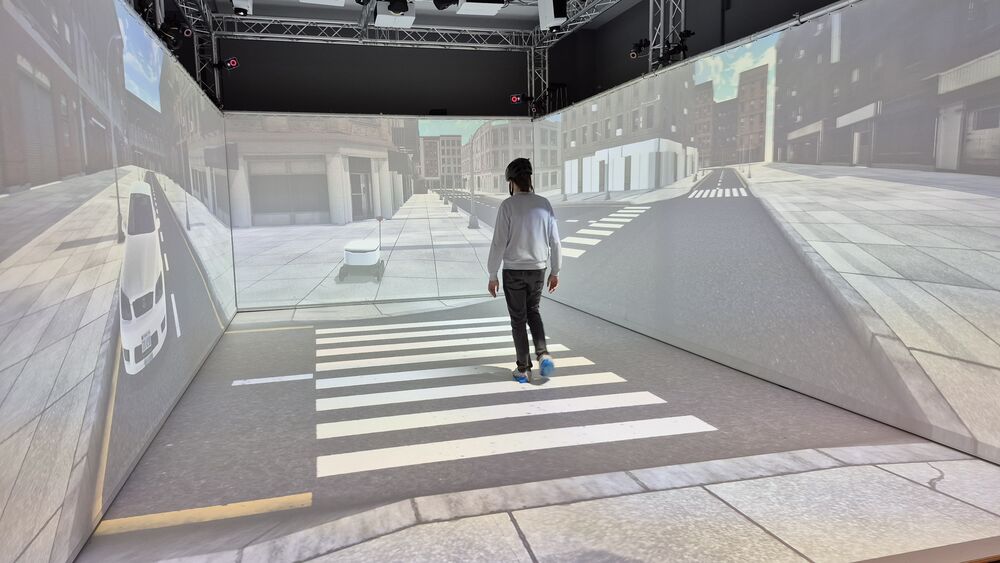
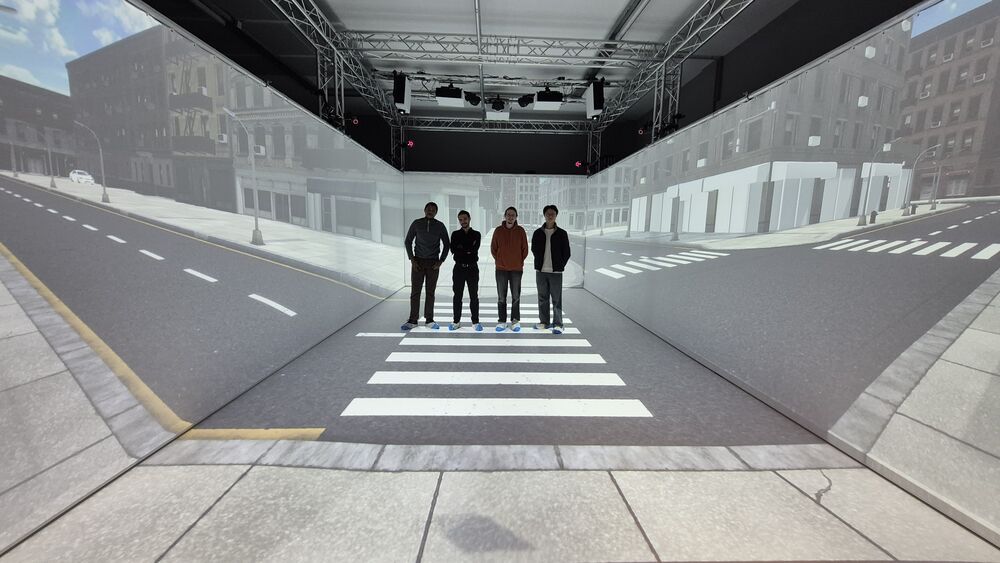


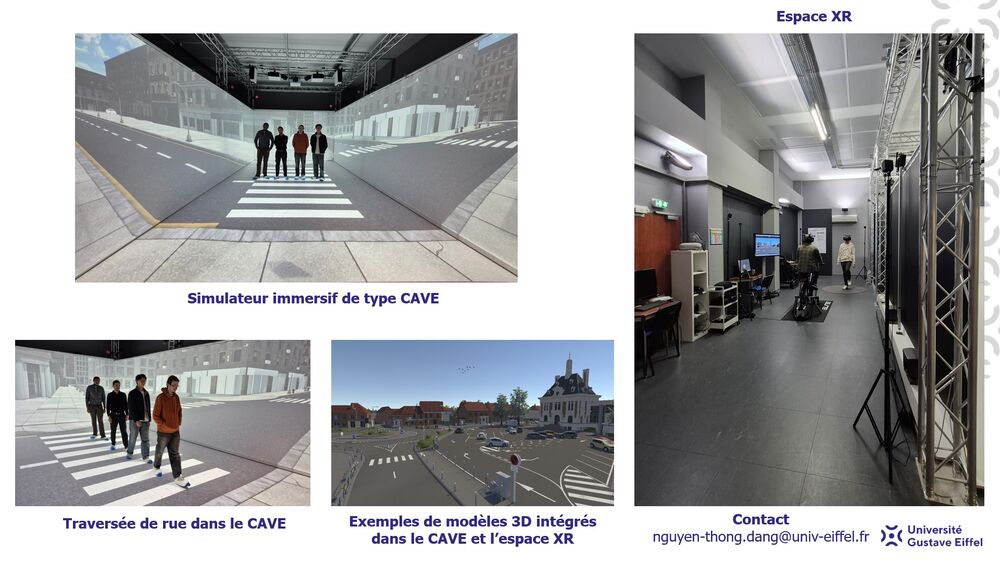
In detail
Developed and managed by the COYS/PICS-L laboratory, this platform is made available to the laboratory’s researchers as well as to partner researchers. The experiments carried out there form part of both the institution’s own research programmes – notably in the context of PhD research – and contract research projects.
The platform’s main activities are centred on two areas:
- The study of user behaviour and interactions in the face of urban transformation and new forms of mobility: analysis of the behaviour of pedestrians, cyclists and drivers in changing urban environments, particularly in light of the gradual automation of vehicles, the development of connected vehicles and the introduction of new autonomous systems in public spaces. This area aims, in particular, to gain a better understanding of the interactions between different road users and to evaluate new configurations for mobility and urban planning.
- The development and application of virtual reality and immersive simulation technologies: acquiring and building on knowledge of immersive technologies, locomotion devices, motion tracking and modes of interaction in virtual environments. This research area focuses on the design, development and evaluation of new simulation methods and systems, as well as on the study of their potential and limitations, with a view to optimising their use for experimental research into mobility, road safety and interaction between humans and autonomous systems.
Immersive simulators are used to evaluate future urban and road developments. They are also used to assess new concepts for travel assistance or signage. In particular, they enable us to assess how users perceive, understand and react to new information or warning messages.
A typical project spans several months and includes needs analysis, the design and preparation of the experiment, and the provision of the simulator for the trials. The client organisation can then conduct the trials with the participants it has recruited and analyse and interpret the data collected using the methods of its choice. In certain cases, we can carry out the testing sessions and process the data.